
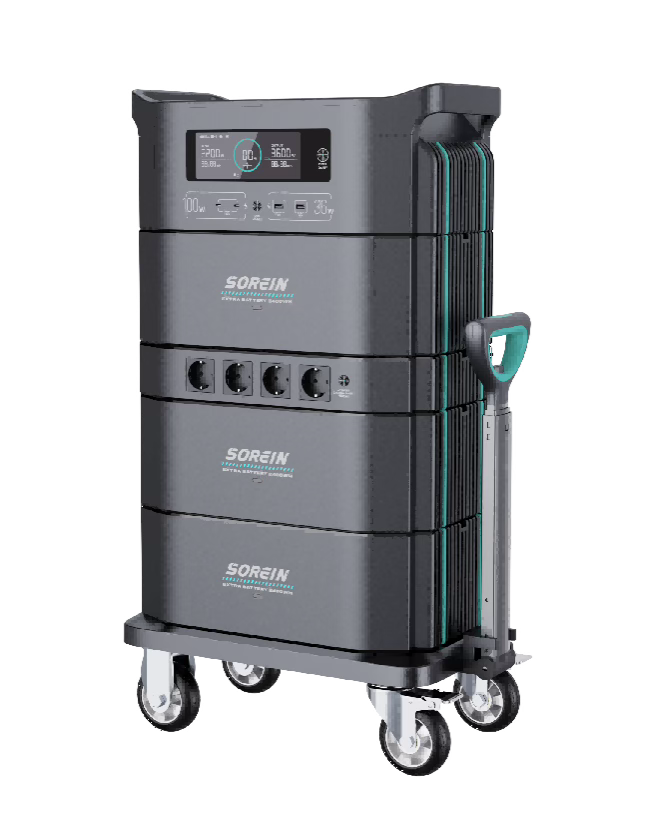
First understand the architecture: a control and inverter base, compatible LFP battery modules, charging interfaces and mobility hardware. Then see how SoreinPower applies the model.
01
What is a modular energy storage system?
A modular energy storage system stores and delivers electricity through separate, compatible units rather than one sealed battery box. Each unit has a defined job, so the system can be configured for the output, runtime and mobility the application actually needs.
The phrase modular energy storage battery usually describes the battery side of that architecture. A battery module stores DC energy in cells and reports its state through a battery management system. The complete modular portable power station is larger than the battery alone: it also needs power conversion, control software, charging inputs, output ports, protection and an enclosure that keeps the system practical to move.
This distinction is important when comparing products. Adding stored-energy modules normally changes how long a system can run. It does not automatically change the inverter's rated output or make every combination compatible.
- Battery modules add stored energy, measured in watt-hours (Wh).
- An inverter converts battery DC into usable AC and determines the supported AC output in watts (W).
- The control and protection layer coordinates charging, discharging, temperature, current and safe limits.
- Connectors, cables, enclosure and mobility hardware make the system usable outside a fixed battery cabinet.
02
What are the parts of a modular power station?
A useful modular system separates energy storage from the parts that deliver and manage power. The exact hardware varies by model, but the architecture can be explained in five layers.
The layers work together as one product, but they should not be treated as interchangeable. Use only modules, connectors and expansion paths approved for the selected system and region.
| Layer | What it does | What changes when you expand |
|---|---|---|
| Main base | Houses the system controller, primary power path and starting output ports. | Provides the platform that compatible modules attach to. |
| Battery module | Stores energy in LFP cells and reports state through its battery management system. | Usually adds capacity and runtime, not inverter wattage. |
| Inverter module | Converts DC energy to AC and, on supported systems, adds a separately managed output channel. | May increase supported output when the approved configuration allows it. |
| Charging interface | Accepts energy from AC mains and compatible solar input within documented limits. | Controls how quickly the expanded system can recover energy. |
| Connection and mobility hardware | Provides connectors, cables, enclosure, wheels or a cart for safe assembly and movement. | Keeps a larger configuration practical to transport and deploy. |
03
How power, capacity and runtime fit together
Output and capacity answer different questions. Output, measured in watts, tells you whether the inverter can start and run a device. Capacity, measured in watt-hours, tells you how much energy is available over time. Runtime depends on capacity, average load, conversion losses and the device duty cycle.
Use the inverter channel to solve the starting and running requirement first. Use compatible battery modules to solve the number of hours. If the loads are correct but the system stops too soon, add capacity; if a tool cannot start, a larger battery alone is not the fix.
- Output check: add simultaneous running watts and check motor or compressor startup demand.
- Runtime check: estimate watt-hours from average load and the required operating window.
- Expansion check: add only compatible modules within the documented voltage, current and configuration limits.
| Measure | Question | Typical response |
|---|---|---|
| Output | Can the system start the device? | Check running watts and startup surge. |
| Capacity | How much energy is stored? | Read the usable watt-hour rating. |
| Runtime | How long will it run? | Usable capacity × reserve factor ÷ average load. |
| Recovery | How will it recharge? | Use AC or compatible solar within charge limits. |
04
How the SoreinPower G Series scales
The SoreinPower G Series is a high-output modular portable power station platform. Start with a focused configuration, then add compatible battery modules when the same loads need to run longer. Add inverter modules only when the approved configuration calls for more independently managed AC output.
Named configurations run from 2.4kWh to 9.6kWh. Compatible linked US configurations can reach up to 55.2kWh and 16.5kW; final capacity, output and supported combinations depend on the exact model plan and regional specification.
| Configuration | Stored energy | AC output | Best starting point |
|---|---|---|---|
| G2400 | 2.4kWh | 3.3kW rated | Focused backup and tools |
| G4800 | 4.8kWh | 3.3kW rated | RV stays and cabins |
| G7200 Pro | 7.2kWh | 6.6kW across two channels | High-draw tools and split loads |
| G9600 Ultra | 9.6kWh | 9.9kW across three channels | Large backup and mobile work |
05
Why modular can be more practical than one oversized unit
A weekend RV trip, a short cabin stay and a multi-day outage do not require the same stored energy. A fixed oversized unit makes every use case carry the same weight and cost. A modular system lets the configuration follow the runtime plan instead.
The same principle applies to mobile work. A base can be selected for the tools you need to start, then additional battery capacity can extend the shift. When a project requires multiple high-demand loads, an approved configuration with extra inverter channels can separate those loads instead of asking one outlet group to do everything.
- RV: add capacity for refrigeration and longer time between hookups.
- Cabin: plan overnight essentials, then recover energy from AC or compatible solar input.
- Tools: match each inverter channel to the tool's running and startup demand.
- Emergency backup: protect the essential layer first, not every appliance in the building.
06
How to size output and runtime
Begin with the devices that may run at the same time. Add their running watts, then check the startup requirement for motors, compressors, pumps and saws. The selected inverter channel should have room above the combined running load.
Then estimate energy with a simple planning formula. A 120W refrigerator running for an equivalent eight hours uses about 960Wh before conversion loss and reserve. Actual runtime changes with duty cycles, temperature, battery condition, inverter efficiency and simultaneous loads.
| Load | Example value |
|---|---|
| Refrigerator | 120W |
| Equivalent operating time | 8 hours |
| Basic energy estimate | 120W × 8h = 960Wh |
| Planning method | Usable capacity × 0.85 ÷ average load |
07
Four situations where modular power fits
Modularity is most useful when the job changes. Instead of asking for one universal configuration, define the loads, hours and recharge plan for the situation in front of you.
- RV travel: refrigeration, connectivity, lighting, entertainment and countertop appliances between hookups.
- Short cabin stays: a temporary system for a refrigerator, router, lights, laptop and planned overnight loads.
- Emergency backup: a critical layer for refrigeration, communications, lighting and essential equipment.
- Power tools: high-output AC for saws, grinders, pumps and chargers where grid power is unavailable.
08
Frequently asked questions
The right configuration starts with the device load, required runtime and recovery plan. These answers cover the decisions that matter before you compare model names.
Questions
Frequently asked questions
What is a modular energy storage battery?
It is a compatible battery module that stores DC energy and communicates its state to a modular power system. It adds stored energy and runtime, while the complete portable power station also needs an inverter, control, charging and protection layers.
What components make up a modular portable power station?
The architecture typically includes a main base, LFP battery modules, an inverter or inverter module, control and battery-management systems, AC or solar charging interfaces, output ports, connectors and mobility hardware.
Does adding a battery module increase output wattage?
Not necessarily. A battery module primarily adds stored energy and runtime. Rated and peak output depend on the inverter and the supported configuration.
Can a modular portable power station run power tools?
Yes, when the selected inverter channel meets the tool's running and startup requirements. Check the tool nameplate and startup demand before use.
What is the maximum linked capacity?
Compatible linked US configurations can reach up to 55.2kWh and 16.5kW. The actual maximum depends on model compatibility and the approved system plan.
Can the G Series use solar charging?
Supported G Series configurations can accept solar input through the documented charging interface. Solar production changes with panel rating, sunlight, shading, temperature and orientation.